Wooden Sunglasses: What to Confirm Before Ordering
Wooden sunglasses inquiries go better when the buyer states the frame style and the quantity in plain words. This guide lists the questions that belong in the inquiry, and it claims no frame specification. Read it as a checklist for the inquiry, not as a description of a frame.
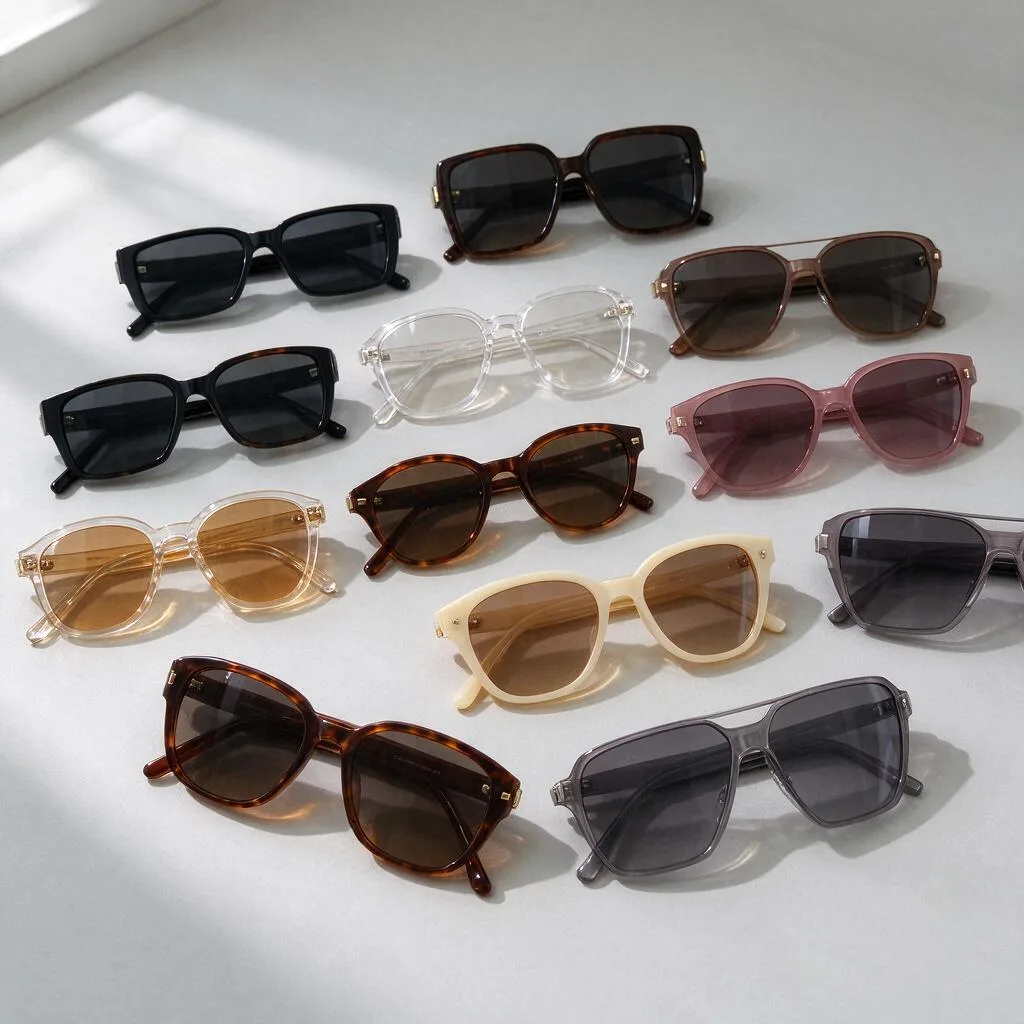
Frame style in plain words
Wood-frame descriptors on this site are supporting terms: they narrow the search, and they do not describe a specification. State the frame style you are asking about in plain words, and add the quantity beside it. A frame line can be short: the style name as the page gives it, the colour or finish beside it, and the quantity beside that.
The image on this page shows an assortment of sunglasses on a plain surface. It is a generic illustration of the range, not a picture of one listed item. The illustration shows the range at a glance; the inquiry itself must still state the frame style in words, because a picture cannot carry a quantity or a type line.
A common mistake is to write only the word wooden and stop there. Wooden is a style family, not an item line. Add the style detail the page gives, the colour or finish, and the quantity, so the reader can match the inquiry line to the range it came from.
Colours, finishes and quantities
State the colours or finishes you are asking about, and the packaging and labelling needs. Where the order is for quantity, the bulk wooden page carries the same confirm points at bulk intent. Colour lines belong beside item lines, not in a closing note where they can be missed.
State your order quantity in the inquiry. Ask the supplier to confirm the delivery schedule in writing. Quantity lines belong beside item lines. Where quantities differ by item, give each item its own quantity, and check at the end that every item line carries one.
Finish lines need the same care as colour lines. A finish word names a surface look, not a specification, and the inquiry should use the finish word exactly as the buyer means it, in plain words. Where a finish is uncertain, say so in the inquiry and ask the supplier to confirm in writing which finish matches the requirement.
Audience and bulk routes
Wooden sunglasses for men sit on an audience page, and bulk wooden sunglasses sit on a B2B inquiry page. The audience page narrows the search by buyer group; the bulk page frames the inquiry around quantity. Both pages lead to the same inquiry form, and both use the same confirm list.
An inquiry that mixes audience and bulk intent should say so plainly: state the audience where it matters, and state the quantity beside each item line. Mixed intent in one block is hard to read, so give each intent its own lines and keep the quantity beside the item it belongs to.
Fashion sunglasses sit beside wooden sunglasses in the range, and buyers sometimes ask about both in one inquiry. Where an inquiry mixes ranges, give each range its own block of lines, so the reader can tell which quantity belongs to which range.
Documents and packaging
List the documents your market requires and ask which can be supplied. Certificates available upon request is the only documents wording on this site. A document list should name each document in plain words, and it should say whether the document is needed for every item or only for one line.
Packaging and labelling needs belong in the same checklist. State the packaging need in plain words, and state the labelling need beside it. Where packaging differs by item, say so line by line. A single packaging line at the end of a long inquiry is easy to read as applying to everything, so mark its scope plainly.
Keep any written confirmation you receive with the quote. That filing habit keeps the item, the quantity and the type in one place when the order is placed. A final read-through catches the usual slips: an item without a quantity, a quantity without an item, and a packaging line whose scope is unclear.
Style detail, bulk blocks and audience blocks
Style detail in a wooden inquiry means the style name as the page gives it, plus the colour or finish beside it, plus the quantity beside that. Three short lines beat one long sentence, because each line can be checked on its own. A style line that tries to carry colour, finish and quantity in one breath is hard to check, and hard to check lines are easy to misread. Where the style detail is uncertain, say so plainly and name the styles under consideration. An uncertain style line that says so is more useful than a confident style line that guesses.
Style lines should match the pages they came from. A style word that appears nowhere on this site cannot be matched by the reader, and an unmatched style word forces a round of clarification. Use the style words the pages give, and where the buyer's own word differs, give both: the buyer's word and the page word beside it, so the reader can match them. Finish lines need the same care as colour lines. A finish word names a surface look, not a specification, and the inquiry should use the finish word exactly as the buyer means it, in plain words.
Wooden inquiries often mix bulk intent with audience intent, and the block method handles that mix. Give the bulk lines their own block, with quantities carrying the bulk intent, and give the audience lines their own block, with the audience word beside the range word. Each block marks its own intent at the top, so the reader never has to guess which intent a line belongs to. Audience blocks need the same lines as any other block: item, style, colour or finish, quantity, packaging, documents. An audience word does not replace any of those lines.
A block that carries only an audience word and a quantity has left out the item, and an item left out cannot be quoted. Bulk blocks need quantities that match items line by line. Count the item lines in the block, then count the quantity lines. The two counts should match. Where a quantity applies to several items, say so plainly beside the quantity, so the reader does not have to guess whether the quantity is per item or for the block as a whole.
Fashion sunglasses sit beside wooden sunglasses in the range, and buyers sometimes ask about both in one inquiry. Where an inquiry mixes ranges, give each range its own block of lines, so the reader can tell which quantity belongs to which range. A mixed inquiry in one block forces the reader to sort ranges while reading quantities, and sorting while reading is where misreading starts. Blocks remove that work, and they let the reader check one range at a time.
Keep any written confirmation you receive with the quote. That filing habit keeps the item, the quantity and the type in one place when the order is placed. A final read-through catches the usual slips: an item without a quantity, a quantity without an item, a style name without a page to match it to, and a packaging line whose scope is unclear. Fix those slips and the inquiry is ready to send through the form on the contact page.
Request a quote
Request a quote: list each item, the quantity, and the lens or frame type you need.